Intended use
Second home, seasonal use or full-time living, described plainly.
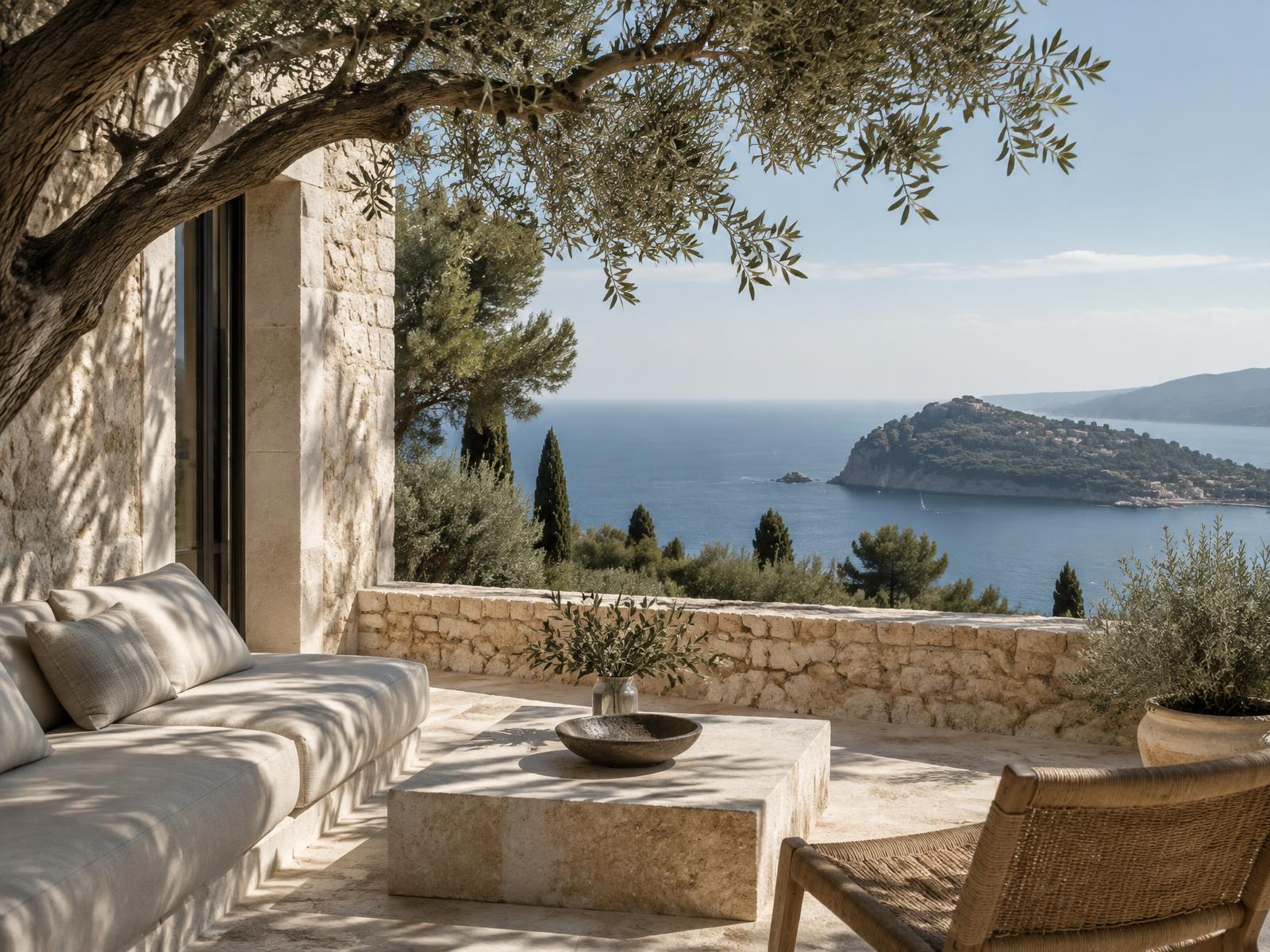
FRENCH RIVIERA BUYER GUIDE
One of the Riviera’s most common trade-offs is also one of the most personal: a stronger view often comes with more elevation, while easier daily life can mean accepting a less dramatic outlook.
Published 23 September 2026 · Updated 23 September 2026
SHOULD I PRIORITISE SEA VIEW OR WALKABILITY ON THE FRENCH RIVIERA?
A sea view can transform how a Riviera property feels, but walkability often determines how easily it is actually used. Buyers who prioritise privacy, terrace living and longer stays may accept more elevation and car dependence for the right outlook. Buyers making frequent short visits may value cafés, shops, beaches and transport within walking distance more highly. The right priority depends on the property’s intended use, not on which feature looks more impressive in photographs.
SECTION 01
The two criteria are rarely in conflict by accident. They are shaped by the same coastal geography.
The geography that creates the view is often the same geography that reduces everyday walkability.
SECTION 02 · 03
Neither is objectively better. Each becomes more valuable in a particular kind of ownership.
WHEN A SEA VIEW DESERVES TO LEAD
A view is not simply visual. Orientation, terrace usability, privacy and exposure determine whether it genuinely changes the ownership experience.
WHEN WALKABILITY SHOULD LEAD
Walkability becomes more valuable every time the buyer uses the property without planning the day around a car.
SECTION 04
Examples of use rather than universal outcomes. Both can change entirely with the exact position.
A SEA-VIEW HILLSIDE PROPERTY
Friday
Arrival, car, parking — the day ends at the property.
Saturday
Driving for errands, lunch or the beach, depending on the exact location.
Sunday
Terrace, view and privacy before departure.
A WALKABLE PROPERTY
Friday
Arrive and leave the car parked.
Saturday
Shops, restaurants or the beach on foot, depending on the micro-location.
Sunday
Easy local use before departure.
The more frequently the property is used for short stays, the more daily friction matters.
SECTION 05
Two properties described as “sea view” can offer very different daily experiences. These are the questions that separate them.
View quality
Open, framed or partial — and from which rooms.
Orientation
When during the day is the view actually enjoyed?
Terrace
Can you comfortably sit and dine there?
Privacy
Is the terrace overlooked from above or beside?
Noise
Does road exposure weaken the experience?
Interior relationship
Can the view be enjoyed from the main living spaces?
Access cost
What practical compromise creates that view?
SECTION 06
On the Riviera, the map rarely describes the walk. What decides it is the route itself.
Five hundred metres on a flat urban street and five hundred metres on a Riviera slope are not the same ownership experience.
SECTION 07
Indicative tendencies to test in person, not conclusions. Micro-location can reverse any line below.
Area / profile
Typical trade-off to test
Walkability can be strong; a sea view depends heavily on the exact position and floor.
Views and privacy can increase as walkability decreases.
An exceptional relationship with the bay may come with slope and stairs.
Privacy and the peninsula setting versus village-level convenience, depending on position.
Monaco access and coastal use versus elevation.
Central, Croisette and Palm Beach convenience versus elevated residential privacy.
Peninsula privacy and the sea relationship versus daily convenience, depending on micro-location.
For a closer comparison of two of these markets, read Nice vs Villefranche-sur-Mer for an international buyer, or, if Monaco access is central to the brief, where to buy property near Monaco on the French side.
SECTION 08
Full-time use magnifies everyday friction — and also rewards privacy more consistently.
WALKABILITY MAY GAIN WEIGHT BECAUSE
A SEA VIEW MAY REMAIN CENTRAL WHERE
Full-time use magnifies everyday friction. A compromise that is charming three weekends a year can become a daily calculation.
SECTION 09
For buyers arriving from abroad, the honest answers to these questions usually settle the hierarchy.
If the search itself is still being organised from abroad, our guide to how to find property on the French Riviera from abroad covers the steps around this decision.
SECTION 10
A way of weighting criteria, not a verdict. Every line remains dependent on the specific property and position.
If you prioritise
Give more weight to
Short frequent stays
Walkability and easy access.
Long relaxed stays
View and privacy may gain weight.
Car-free use
Walkability.
Terrace lifestyle
View, plus genuinely usable outdoor space.
Privacy
Elevated or lower-density options.
Restaurants and cafés
A walkable centre or village position.
Family independence
Walkability.
Property as a retreat
View and privacy.
Monaco daily access
The practical route, before the view.
SECTION 11
The decision is not always binary. Some positions carry part of both criteria — though no position carries all of each.
The strongest search is often not “sea view or walkability?” but “how much of each do I actually need?”
WHAT SOME MICRO-LOCATIONS CAN COMBINE
Each of these has to be verified on site. A position that satisfies every line at once is rare, and should be treated as an exception rather than a target.

SECTION 12
Choosing the view from listing photographs.
Testing walkability only on a map.
Ignoring the return walk uphill.
Underestimating parking and luggage.
Treating all sea views as equivalent.
Failing to connect the priority to actual property usage.
SECTION 13
The hierarchy is established before properties are presented, then tested against real positions.
Second home, seasonal use or full-time living, described plainly.
How often the property will realistically be used.
How much daily driving is genuinely acceptable.
What must be reachable on foot, and what need not be.
Where the outlook sits in the hierarchy, honestly ranked.
Outdoor living defined before properties compete.
Specific sectors selected against those criteria.
Built against identical criteria, so comparison is real.
The walk, the slope and the parking checked in person.
Recorded property by property while impressions are fresh.
VEYREL treats sea view and walkability as competing criteria to calibrate, not marketing labels to maximise.
Start Your Private Property SearchWHERE TO GO NEXT